

Leather buying guide: how to choose leather that lasts
What the words on a leather label mean, five things to check before you buy, and how vegetable-tanned leather changes over the years you carry it.

At a glance
- Choose full grain, vegetable-tanned leather. It keeps the hide's natural surface, so it ages into a patina instead of wearing through.
- In the hand, check five things: the grain, a bevelled and burnished edge, tight even stitching, the thickness (ours is 1.4 mm) and hardware that sits flush.
- Chestnut and Whisky show patina and engraving most clearly; Charcoal and British Racing Green keep both subtler.
- Every Wingback leather piece is hand-stitched in London from Tuscan full grain leather and guaranteed for life: if it fails through a fault in materials or making, we repair or replace it.
Leather is sold with a vocabulary that sounds reassuring and explains very little. Two wallets can look identical on a screen and age in opposite directions, and the words on the label are the only clue you get before the parcel arrives. This guide sets out what those words mean, what to check once the piece is in your hand, and how the right leather changes over the years you carry it. We make everything from one kind of leather, so we will say why, without running down anyone else's choices.
Every piece we cut is full grain, vegetable tanned, environmentally certified leather from a tannery in Tuscany, near Florence, machine-cut and hand-stitched in our London workshop. That sentence is the whole answer to what lasts. The rest of this guide explains it.
What the words on the label mean
Most of the confusion comes from a handful of terms that are used loosely. Knowing them is the most useful thing you can do before spending any money.

Full grain, top grain, genuine and bonded
Full grain is the hide with its natural outer surface left on: the pores, the fine creases, the odd mark from the animal's life. Nothing has been sanded away. That outer layer has the densest fibres in the hide, so it is the strongest part, and it is the only part that develops a true patina. Top grain has had that surface buffed off and a finish applied. It is even and easy to work with, and it will stay looking much as it did on day one. Genuine leather reads like a grade and is not one. It only means the material is leather, and it is usually cut from the lower, looser layers of the hide. Bonded leather is offcuts ground up and glued to a backing, and it tends to crack and peel. We use full grain because it is the part of the hide that was built to be carried.
Vegetable tanned and chrome tanned
Tanning turns a raw hide into stable leather, and the method decides how the leather feels and ages. Chrome tanning takes hours and gives a soft, colour-fast leather that stays as it started. Vegetable tanning uses tannins from bark and plant matter and takes weeks. The leather comes out firm, with a warm scent that most people notice before anything else, and it is the reason our wallets soften with handling and darken into a patina rather than staying static. Both methods are legitimate. We choose vegetable tanning because ageing well is the point of the object.
Five things to check in the hand
You do not need specialist knowledge to judge leather goods. Five checks tell you most of what matters.
- The grain. Look for pores and slight variation across the surface rather than a flawless, uniform sheen. Full grain has texture, and a small natural mark is a good sign, not a flaw.
- The cut edge. The quickest tell. A finished edge is bevelled and burnished, so it is rounded, smooth and sealed. A painted edge looks tidy when new and chips as it wears.
- The stitching. Stitches should be even, straight and pulled tight, with no loose ends. Ours are hand-stitched in London with Amann Serafil high-tenacity thread from Germany.
- The thickness. Too thin and leather goes limp and tears at the stress points. Too thick and it will not fold cleanly. Ours is 1.4 mm, enough to feel substantial and still break in.
- The hardware. Metal should feel dense and sit flush. The fasteners on our Cash Wallet and Travel Wallet, and the Block Buckle, are machined in England from brass or stainless steel.

How does vegetable-tanned leather age?
A new piece feels firm, close to reluctant, and that is how it should be. Over the first weeks it softens and takes the shape of what it carries, so a wallet holds its cards more snugly as it goes. The natural oils from your hands work into the surface and the colour deepens. It picks up small marks along the way, and most of them smooth into the surface rather than sitting on top of it.
A mark on full grain leather is the start of a patina, not the end of a finish.
We describe the mechanism rather than promise a result, because every hide and every owner differ. Upkeep is light, and our guide on how to care for a leather wallet and re-oil it covers everything it needs.
I've had this wallet for five years with no signs of stopping. It's aged very well, even with having survived a good number of accidental spins in the washer.

Which colour should you choose?
Colour is the one decision where taste should lead, and with leather that is reason enough. We offer four, and every leather piece comes in all of them: Chestnut, Whisky, Charcoal and British Racing Green.
- Chestnut and Whisky are the lighter tones. They show patina most clearly over the years and take an inscription boldly, so the lettering reads crisp.
- Charcoal and British Racing Green are deeper. Patina develops just as surely and stays subtler, and an inscription on them is softer to the eye.

The rule for engraving is simple: the lighter the leather, the bolder the mark. Our engraving is done by our engraver in South London.
Buy for what you carry now
Our wallets soften and conform to their contents, so you can gradually increase what you carry but not easily reduce it. Start close to the capacity you actually use.

The Wingback leather range
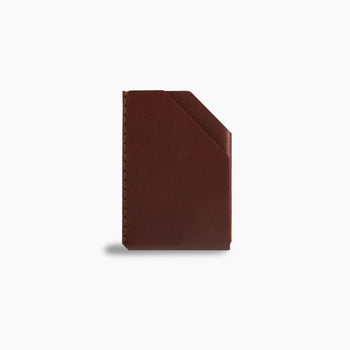
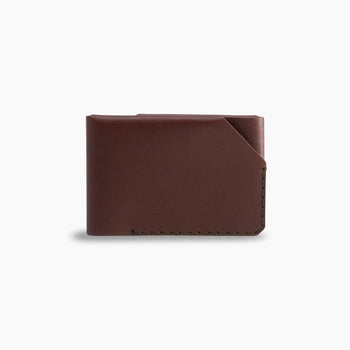
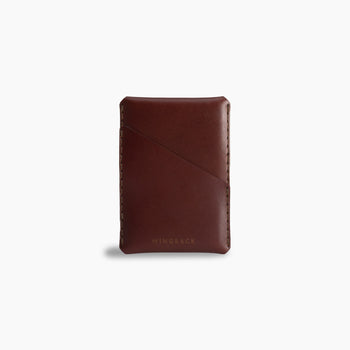
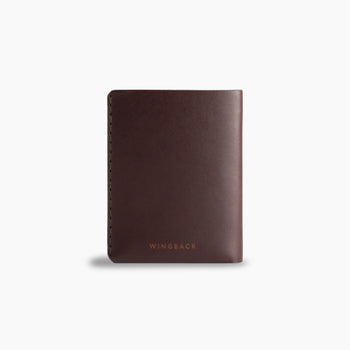
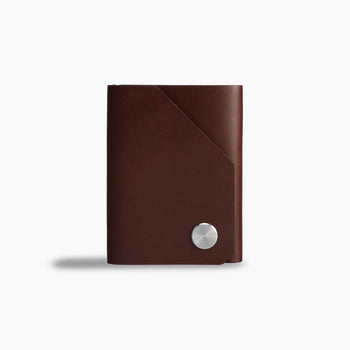
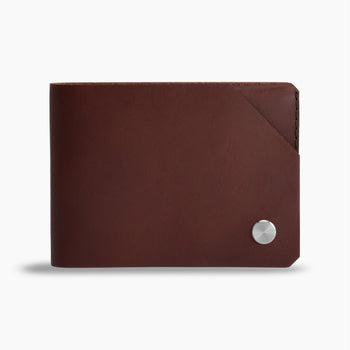
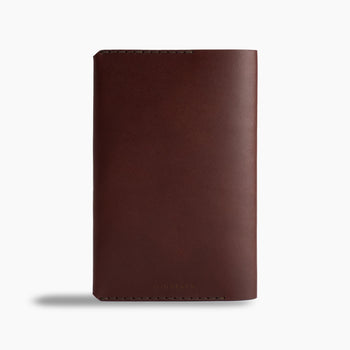
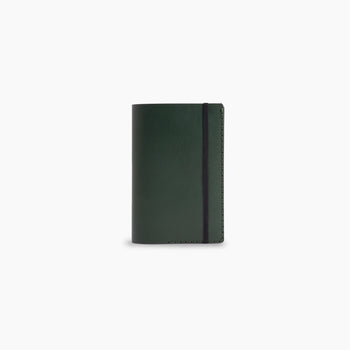
Every piece below is cut from the same Tuscan full grain leather, so the choice comes down to what you carry and the shape that suits your pocket. The wallets are listed from the slimmest up, shown in a mix of the four colours; every piece comes in all of them.
| Piece | Carries | |
|---|---|---|
 |
The Original Card Holder | 2-5 cards, folded notes |
 |
The Original Card Wallet | 8+ cards, folded notes |
 |
Winston Card Holder | 2-8 cards, folded notes |
 |
Winston Wallet | 2-10 cards, 10+ notes, a passport |
 |
Cash Wallet | 2-5 cards, 15+ notes flat |
 |
Travel Wallet | Passport, boarding pass, 4-6 cards, notes |
 |
Winston Travel Wallet | Up to 3 passports, 12 cards and 20+ notes |
 |
Pocket Refillable Notebook | Any 9 x 14 cm notebook |
 |
Medium Refillable Notebook | Any 11.5 x 18 cm notebook |
 |
Leather Pen/Pencil Sleeve | One pen or pencil |
 |
Pen Slip | Up to 5 pens or pencils |
 |
Block Belt | Reversible strap, two colours; eight combinations in the full set |
Our guarantee
Every Wingback is guaranteed for life. If a piece fails through a fault in its materials or making, we repair it or replace it, however long you have owned it. Fair wear, patina and the marks of use are part of the story, not a fault, and most of what we make can be restored to its original finish.
Repairs are carried out in our London workshop. Send your order number and a photo of the problem and we will tell you what we recommend and, in the rare case of extreme damage, what it would cost before any work starts. The full terms are on our guarantee and repairs page.
Once you have settled on the leather, the remaining question is the shape for your pocket, and our guide to which Wingback wallet is right for you takes it from there.
The Wingback Team














Leave a comment