

How to care for a leather wallet (and re-oil it)
Full-grain leather asks very little of you, but a little care now and then goes a long way. Here's how to clean, condition and re-oil your Wingback wallet so it ages beautifully for years.

At a glance
- To care for a leather wallet, wipe it with a soft dry cloth to keep it clean, keep it out of prolonged damp and direct heat, and re-oil only when the leather starts to look or feel dry.
- For our full-grain vegetable-tanned leather, a light coat of a neutral leather conditioner once or twice a year is plenty for most people.
- Apply sparingly with a soft cloth, let it absorb, then buff. Over-oiling darkens the leather and softens it more than you might want.
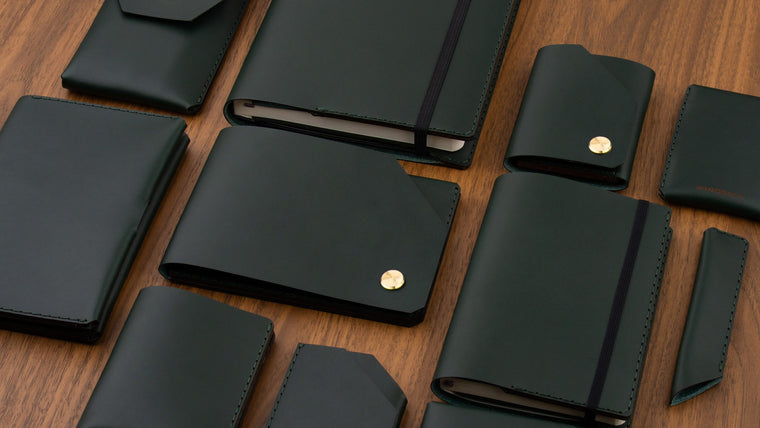
Caring for a leather wallet mostly means leaving it well alone. Our wallets are made from full-grain, vegetable-tanned leather from Tuscany, and that kind of leather is built to be used rather than fussed over. It softens with handling, picks up a patina that becomes uniquely yours, and only really needs your attention when it starts to look a little dry. Below is everything worth knowing, from day-to-day cleaning to the occasional re-oil. The same care applies to a refillable leather notebook cover, cut from that very same Tuscan hide. If you are weighing up a new piece, our guide to choosing leather that lasts explains what to look for in the hand.

How do I clean a leather wallet?
For everyday cleaning, a soft dry cloth is all you need. Give the outside a gentle wipe now and then to lift off dust and the oils from your hands, and that keeps things looking their best without any real effort. If it picks up a mark or a splash, wipe it promptly with a barely damp cloth and let it dry naturally at room temperature.
What to avoid
Soaps, solvents and baby wipes strip the leather of the very oils that keep it supple. A barely damp cloth is as far as you should ever go.
Every scuff and shine it picks up is the wallet becoming yours, not a fault to be polished away.
How often should I re-oil or condition it?
Less often than you'd think. For most people carrying a wallet daily, a light conditioning once or twice a year is plenty. Rather than working to a strict schedule, let the leather tell you. When the surface starts to look a touch matte, feels dry to the touch, or the colour seems to have lost a little of its depth, that's the moment to feed it.
Vegetable-tanned leather naturally darkens and warms with age and handling, so a slightly deeper colour on its own isn't a sign it needs oiling. Dryness is what you're watching for, not richness.

How to re-oil a leather wallet, step by step
Use a neutral, good-quality leather conditioner or a balm made for smooth leather. A neutral or colourless product is the safest choice, since it won't shift the colour of your wallet. Here's the whole process:
- Start clean. Empty the wallet and wipe it down with a dry cloth so you're not sealing dust into the leather.
- Less is more. Put a small amount of conditioner onto a soft cloth rather than straight onto the leather.
- Work it in. Use light, circular motions across the outer surfaces, keeping the coat thin and even.
- Let it absorb. Leave it for a little while, ideally somewhere cool and out of direct sun.
- Buff back. A gentle pass with a clean, dry cloth brings back a soft sheen.
A quick word of caution: over-oiling is the most common mistake we see. Too much conditioner will darken the leather noticeably and can leave it softer and floppier than you'd like, which matters with a slim card holder that you want to hold its shape. If you're unsure, do a tiny amount first, see how the leather responds, and build up from there.
A lovely and quality piece that is already aging well with use. A perfect EDC item with character.
How do I keep the leather from drying out in the first place?
Prevention is easier than any cure. The two things leather really dislikes are prolonged damp and direct heat, so the simplest habits make the biggest difference. Don't leave your wallet on a sunny windowsill or next to a radiator, as concentrated heat dries leather out and can make it brittle over time. If it gets caught in the rain, let it dry naturally and slowly rather than forcing it with a hairdryer or the airing cupboard.
Carrying it regularly helps too. The natural oils from your hands keep the leather conditioned far better than any product, which is part of why a well-used wallet often looks and feels better than one that's been sitting in a drawer. This is very much the spirit of buying less and buying better: one considered piece, used daily and looked after simply, will outlast a stack of throwaway ones.
Does this apply to all Wingback leather pieces?

Yes. Whether you carry the slim Original Card Wallet, the Winston Card Holder, the note-friendly Cash Wallet or the Travel Wallet, they're all made from the same full-grain, vegetable-tanned leather, so the same gentle routine applies to every one. If you'd like a little more background on how the Cash Wallet came together, we wrote about it in the story behind its design. And if you're still deciding which one to carry in the first place, our guide to choosing the right Wingback wallet compares all four.
And because every piece is cut, stitched and finished by hand here in the UK and carries our lifetime guarantee, if something ever goes wrong that a wipe and a little conditioner can't fix, we're always happy to take a look and put it right.
Look after it lightly, use it often, and let the patina do its thing. That really is all there is to it.
The Wingback Team








Leave a comment